Central to delivering a preclinical radiation dose for therapeutic evaluation is understanding how deeply and uniformly the X-ray beam can penetrate and irradiate a biological sample. Previously, we noted that beam quality is defined by two characteristics: average beam energy (or beam penetrability) and beam homogeneity (or the uniformity of the beam energies).
Improving Depth Dose Uniformity
Beam homogeneity describes the spectrum of energies and how evenly the energies are distributed across the irradiation field. We discussed in our last installment that the energies comprising a beam are each capable of penetrating a given sample to a particular depth. A beam with a wider spectrum of energies would have lower depth dose uniformity within a biological sample. When such a beam is distributed across an irradiation field, it is likely to cause deleterious effects to the sample, such as skin burns. The smaller the spectrum of energies that make up the beam, the more radiation that will be delivered to a uniform depth. A smaller spectrum at higher energy, sufficient to reach the target within the sample (i.e. high dose uniformity), will have fewer adverse outcomes. Higher depth dose uniformity is a characteristic of higher beam quality.
The Heel Effect
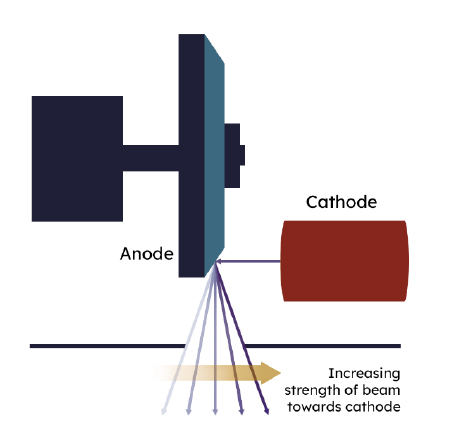
The heel effect is an inherently fundamental aspect of X-ray technology that asymmetrically affects the radiation dose field, thereby reducing spatial uniformity (see Figure 1).
To compensate, turntable rotation should be used to average the heel effect, which will result in a more spatially uniform field. The example below illustrates how the turntable achieves greater spatial uniformity in the XCELL® 180 benchtop irradiator from KUBTEC Scientific.
Improving Spatial Dose Uniformity
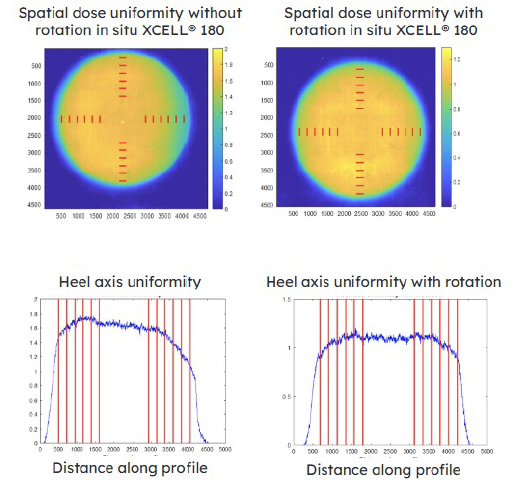
It is worth noting that the XCELL 180 was designed with a novel aperture that minimizes the heel effect. Spatial uniformity is further improved in this system by the addition of rotation - a combination that results in a unique and highly uniform spatial dose distribution.
A uniform spatial dose distribution allows the user to deliver a dose to their study subject that results in a more predictable and reproducible outcome. A major aspect of overall beam quality, spatial dose uniformity can help guide the decision for the right irradiation system in a research lab. Along with reliability, price, and footprint, considering beam quality (energy, and depth and spatial uniformity) can ensure that your X-ray irradiation system has the characteristics that will best suit your needs.
In the next installment, Why Using Irradiation Filters Matters, we’ll explore what irradiation filters are and why they are so critical for achieving a high-quality beam….
